A Book by Ritesh Singh · 2026

Nobody said  no.
And yet nothing  moved.

Most startups don't break in the market.

They break in the room.

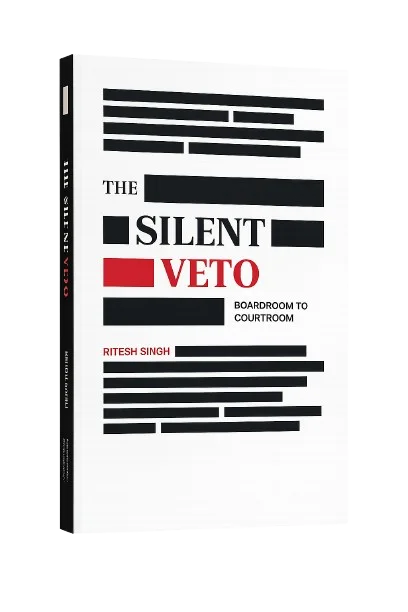
The Silent Veto · Boardroom to Courtroom A book on what founders don't say , and what it costs them.
The Silent Veto Book Cover
§ 01 · Pattern

Everything looks aligned.
Until it isn't.

65% of high-potential ventures don't fail because of the market. They fail because of the room.

, Harvard Business School
// 01

The meeting ends in agreement. Nothing changes after.

Decisions aren't killed, they're deferred. Politely. Repeatedly. Until urgency replaces strategy.

// 02

The real conversation already happened, without you in it.

By the time something reaches the table, it's been shaped in a side chat, pre-decided in a smaller room. The meeting is theatre. The veto already passed.

// 03

Everyone nods. No one means it.

The board sees alignment. The team sees contradictions. What looks like consensus is actually choreography, founders performing agreement because disagreement feels too expensive.

This is not conflict.
This is the silent veto.
And it's already in your boardroom.

Section 01 of 10
§ 02 · Idea

It's not a moment.
It's a mechanism.

The silent veto doesn't arrive as a single event. It operates as a system, four interlocking patterns that compound until the structure cracks.

// 01, Manufactured Consensus

Agreement without commitment.

Everyone agrees in principle. No one commits in practice. Decisions pass without objection and die without execution. The founders call it alignment. It's actually avoidance.

// 02, Selective Transparency

Information flows unevenly.

One founder briefs the investor. Another updates the team. A third hears about it last. No one is lying. But no one has the full picture either.

// 03, Partial Commitment

Effort that comes and goes.

One founder is all in on Mondays, checked out by Thursday. Another leads the pitch but disappears during delivery. Excused as "everyone has their style." The company runs on whoever shows up most.

// 04, The Quiet Coalition

A gravitational pull.

Two founders develop a rhythm, shared breaks, private chats, parallel decisions. The others feel it but can't name it. It's not a conspiracy. It's a tilt that slowly bends every room.

§ 03 · Consequence

From boardroom to courtroom.

The distance between a boardroom and a courtroom is shorter than most founders think.

// Stage 01, First

The company pays first.

Decisions stall. Hiring freezes because founders can't agree on who to bring in. Product roadmaps drift because no one has the authority, or the will, to choose a direction. The burn rate stays the same. The output quietly halves.

// Stage 02, Next

The people pay next.

Employees start receiving different versions of the same plan from different founders. The best ones leave first, not because the company failed, but because the leadership stopped making sense. Investors get evasive updates. Board meetings become performances.

// Stage 03, Last

The laws pays it lasts.

What could have been a conversation becomes a legal notice. Equity gets frozen. Company funds go toward litigation instead of growth. Personal savings drain. Families get pulled in. The partnership that started with a handshake ends with affidavits.

Every founder thinks this is someone else's story.
The data says otherwise.

90% of Indian startups fail within five years. 23% of all startup failures globally cite team breakdown as a primary cause. The number where it was a contributing factor is almost certainly higher, it's just easier to blame the market.

, CB Insights · Inc42
Section 03 of 10
§ 04 · The Book

Not advice.
Architecture.

This book doesn't tell you what to feel about your co-founder. It gives you a system for seeing what's actually happening, and tools to act before the window closes.

// 01

A diagnostic for what "fine" is hiding.

The four patterns of the silent veto, mapped against real founder breakdowns. You'll stop mistaking silence for agreement.

// 02

The 4-stage collapse model.

Drift. Distance. Dysfunction. Break. Most teams are already at Stage 2 by the time they notice. You'll learn to read Stage 1.

// 03

The cultural traps no one warns you about.

Why Indian founders form teams faster than they should. Why hierarchy hides inside flat structures. Why "we've never had a fight" is the most dangerous sentence in a startup.

// 04

The investor blind spots that accelerate breakdown.

Forced specialisation. Selective backchanneling. Tactical triangulation. How external capital unintentionally fuels internal fractures.

// 05

The conversations founders avoid, scripted.

Not motivational frameworks. Actual conversation architectures for equity, role clarity, exit, and accountability, designed for teams of three, four, five founders.

This is not theory. It is pattern recognition across twenty-five years, dozens of founder stories, and one very personal legal battle.

Section 04 of 10
§ 05 · First Look

Read the first
few pages.

Preface · Before the Room Breaks pp. i–iii
1 / 2

The full book releases June 24, 2026.
Be the first to read it.

Section 05 of 10
§ 05 · Audience

Better partnerships build better companies.
This book helps you create both.

Founder
You're building something that matters, with people you chose deliberately. The energy is real. The ambition is shared. But the best partnerships aren't the ones that avoid hard moments. They're the ones designed to navigate them.
65% of high-potential startups that fail do so because of co-founder dynamics, not product, not market (Noam Wasserman, HBS). The founders who beat those odds aren't luckier. They're more intentional about partnership design from day one.
Operator
You sit between the founders. You see the gap between what they say in all-hands and what actually happens in execution. You've watched priorities contradict each other across teams. You've wondered if you should say something. You haven't.
Startup employee attrition runs at 25%, double the national average. Half of all startup employees leave within three years. The most common reason isn't compensation. It's leadership dysfunction they can see but can't fix.
Investor
You've backed strong markets and strong products that still failed, and the post-mortem never quite explained why. You evaluate decks, TAM, and traction. But the thing that kills your portfolio companies isn't in the deck.
CB Insights reports 23% of failures cite "team issues." Categories like "ran out of cash" and "pivoted too late" often mask the real cause, founder paralysis underneath. Y Combinator's data shows the #1 predictor of success isn't the idea. It's how long the co-founders knew each other before starting.
Ecosystem
You advise founders, teach entrepreneurship, or run accelerator cohorts. You've seen promising teams fracture and attributed it to "fit." You teach lean methodology, customer development, and fundraising. But how much of your curriculum covers the thing that actually kills most startups?
Only 18% of first-time founders succeed. Accelerators boost funding odds by 3.4%, but almost none offer structured training on co-founder dynamics or partnership design. The most dangerous gap in the startup ecosystem isn't capital. It's relational infrastructure.

If you've ever sat in a room where everyone agreed and nothing moved,
you already know the pattern. This book names it.

Section 06 of 10
§ 06 · Author

This book exists
because a partnership didn't.

Ritesh Singh - Author Portfolio

Ritesh Singh has spent twenty-five years across global agency networks, high-growth startups, family-run businesses, and cross-border advisory, in India, the Middle East, Southeast Asia, and the United States.

He left a corporate career with seven months of savings and a newborn at home to co-found a venture with people he respected. They had complementary skills, shared ambition, and genuine chemistry. They spent more time researching their office lease than understanding each other's conflict patterns. It didn't end in the market. It ended in a courtroom.

The legal battle that followed lasted years. But the deeper work began after, a systematic study of why bright, well-intentioned founders so predictably drift apart. Dozens of founder stories. Psychological research. Cultural patterns across India and global ecosystems. Six complete drafts over seven months.

What emerged is not a memoir. It's a framework, built on pattern recognition, not theory, for seeing what most founders only recognise in hindsight.

Today, through Espressoshot Consulting, Ritesh advises founders, boards, and leadership teams navigating moments of misalignment, transition, and scale.

The most critical breakdowns are rarely loud. They are silent, layered, and cumulative. This book is an attempt to name, and confront, that pattern.
§ Design · Philosophy

The cover is not decoration.
It's evidence.

Krishnapriya Dutta Gupta - Design Evangelist
Krishnapriya (KP) Dutta Gupta
Design Evangelist
Ex-Google · Ex-Ogilvy
MFA, Academy of Art University, San Francisco

Every black bar on this cover represents something unsaid, a conversation deferred, a truth swallowed, a disagreement buried under politeness. The design language mirrors the book's thesis: what you can't see is often more important than what you can.

The redaction motif came from a simple question: what does silence look like on paper? Legal redactions hide information to protect someone. In founder partnerships, silence hides information too, but it protects no one. The black bars are not censorship. They are the visual form of avoidance.

, Kris, on the design

The single red bar breaking through the black is the book's turning point made visible, the moment a founder stops accommodating and starts confronting. It is silence being interrupted.

Read the full design story →
Section 07 of 10
§ 07 · Reception

What early readers are saying.

"This names what most founders experience but never articulate."

Early Reader

Founder · Series B · Bengaluru

"A sharp, uncomfortable, and necessary read."

Early Reader

Investor · Early-Stage VC

Section 08 of 10
§ Media

Conversations around the book.

The Silent Veto is sparking conversations about what startup culture celebrates, and what it ignores. Podcast appearances, interviews, and panel discussions will be featured here as they go live.

First episodes dropping around launch.

Stay tuned. Subscribe via the launch list to get notified when the first conversations go live.

Hosting a podcast?

Interested in having Ritesh on your show?
hello@espressoshot.consulting

Speaking & workshops.

For founder retreats, investor summits, and accelerator cohorts.
hello@espressoshot.consulting

§ Thinking

Writing that shaped the book.

Ideas from The Silent Veto started as essays, observations, and arguments, some published, some still evolving.

// 01, Founder Dynamics

The Silent Drift Between Founders

The story of founders is often told as one of shared dreams and unbreakable bonds. But beneath the surface lies a more complicated truth.

Read essay →
// 02, GTM Strategy

GTM Strategies That Don't Burn Teams

GTM strategies should not come at the cost of your team's well-being. The heroic hustle myth is hurting creativity and retention.

Read essay →
// 03, Design Story

The Design Philosophy Behind The Silent Veto

How redacted documents, visible silence, and a single red bar became the visual language for a book about what founders don't say.

Coming soon →
§ 08 · Details

Book snapshot.

// Format
Paperback · Kindle
Audiobook (coming soon)
// Languages
English
Hindi edition planned
// Categories
Startups · Leadership
Founder Dynamics
// Available on
Amazon India · Flipkart · Kindle Store · Direct purchase
Pricing announced closer to launch.
Section 09 of 10
§ 09 · Action

If you're building with someone, this isn't optional reading.

// Pre-Launch List

Be the first to read it. Drop your email, we'll notify you on launch day.

By submitting you agree to receive launch updates. Unsubscribe anytime. Privacy Policy

//

Bulk & Corporate

Teams · Cohorts · Boardrooms

//

Speaking
& Workshops

For founder retreats, investor summits, accelerator cohorts

//

Read more
about the author

Twenty-five years across boards & rooms

Section 10 of 10